



June 15, 2026
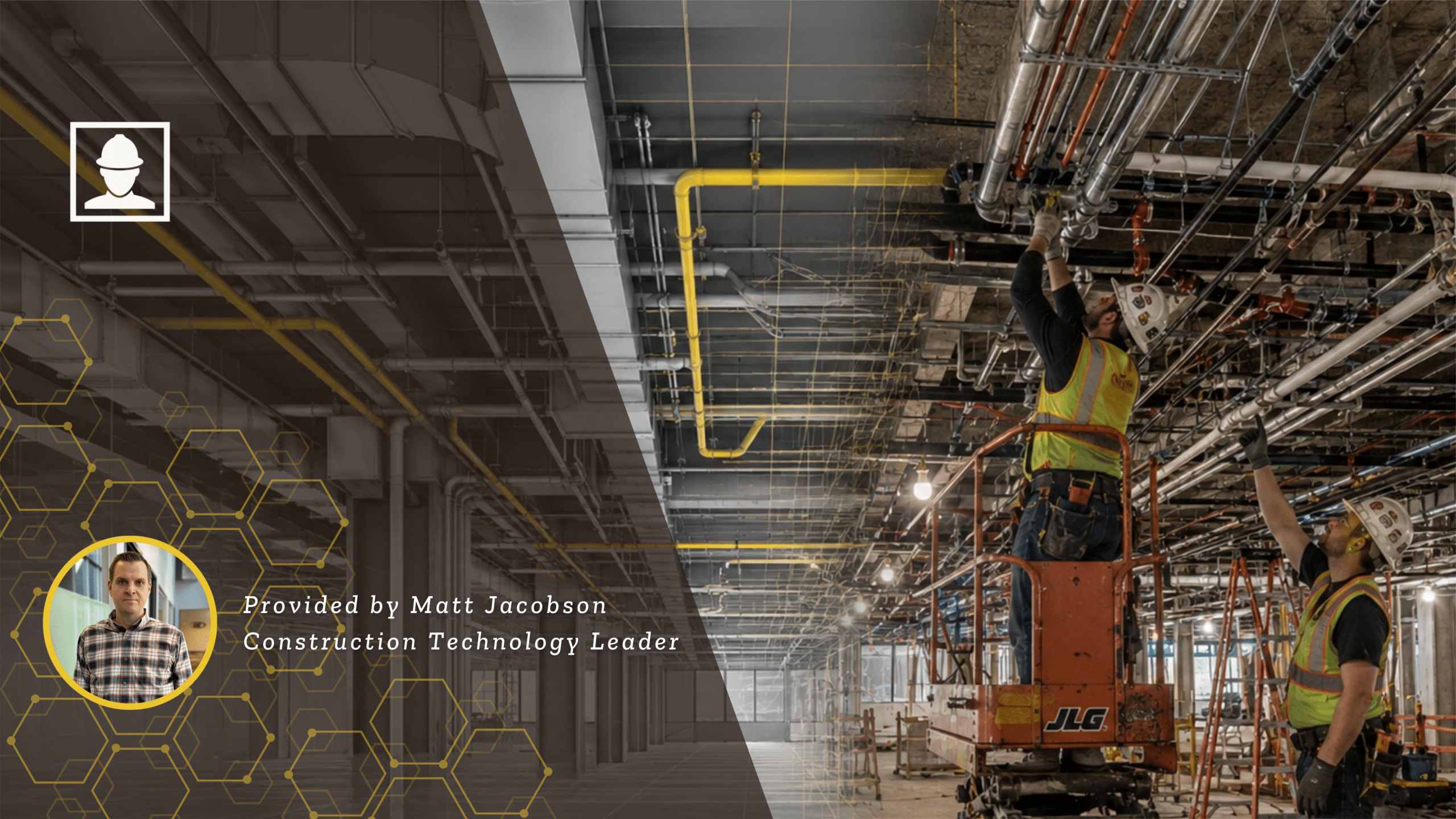
Provided by Matt Jacobson, Construction Technology Leader
“We’ll figure it out in the field” is one of the most familiar phrases in construction. Sometimes, it reflects confidence. Experienced field teams are incredibly capable. They solve problems every day under pressure, often with limited information, tight schedules, and real-world constraints that no drawing set can fully anticipate.
But that phrase can also hide a costly assumption.
When we wait to solve problems in the field, the options are usually narrower, more expensive, and more disruptive. Crews are already mobilized. Equipment is already rented. Materials may already be fabricated, ordered, or staged. Trades may already be working around each other. The schedule may already be compressed.
The field can solve almost anything. The better question is: should it have to?
That is where Virtual Design and Construction changes the conversation. VDC is not just clash detection. It is not a model created so someone can say the project was “coordinated.” At its best, VDC is a decision-making environment. It gives the right people a place to see problems earlier, test solutions earlier, and make better decisions before those decisions become expensive in the field.
The value is not the model itself. The value is what the model allows the team to understand, decide, and prevent.
The Cost of Solving Problems Late
Every project has uncertainty. Some of it hides in design intent. Some hides in constructability. Some hides between trades. Some hides in assumptions about access, sequence, material handling, or installation logic. Those uncertainties do not disappear when construction starts. They move downstream.
If they are not resolved early, they eventually show up in the field as questions.
- Can this duct actually pass through this space?
- Can the sprinkler line maintain coverage with the steel and lighting layout?
- Can the lift reach the work safely?
- Can one trade finish before the next trade needs access?
- Can the material be installed in the order the schedule assumes?
When those questions surface after crews are in place, the answer usually costs more.
It may cost time through an RFI, a stop in production, or a trade waiting on clarification. It may cost money through rework, material changes, remobilization, or additional equipment rental. It may cost quality if the team is forced to compromise design intent just to keep work moving. And it may cost safety when people are asked to improvise in congested spaces under schedule pressure.
That is why “we’ll figure it out in the field” is risky. Not because the field lacks the ability to solve problems, but because solving problems late puts unnecessary burden on the people already carrying the most pressure.
VDC moves that burden upstream, where there is still room to think clearly, evaluate options, involve the right people, and make decisions before crews are waiting.
More Than Clash Detection
For many people, VDC still gets reduced to clash detection. Clash detection matters. Finding a duct running through a beam or a pipe crossing another system is useful. But if that is all we expect from VDC, we are underusing it.
The real power of VDC is understanding how the building will actually come together.
A good VDC process helps answer practical field questions before installation begins.
- What needs to go in first?
- What trade needs access next?
- Where does material move through the space?
- Where can lifts be positioned?
- What should be prefabricated?
- What can be installed from the floor?
- What creates risk if it is delayed or resequenced?
That is why I think of VDC less as a digital model and more as a shared planning space.
It allows superintendents, project managers, trade partners, designers, safety professionals, and field leaders to look at the same conditions together. Instead of each group interpreting drawings through its own lens, the team can gather around a common visual language.
That matters because construction is full of decisions that are technically small but operationally significant. A hanger location, valve access point, lighting layout, penetration, pipe rack elevation, or material staging area may not look like a major issue in isolation. But in the field, those decisions affect productivity, access, safety, sequencing, and quality.
In plain language, VDC lets us build the project together before we build it for real.
Bringing Field Knowledge Forward
One of the most important parts of VDC has nothing to do with software. It is who gets involved, and when.
The people closest to the work often understand constructability better than anyone. Superintendents, foremen, and trade partners know how work is actually installed. They know what can be reached safely, what sequence makes sense, what will create congestion, and what looks good on paper but becomes difficult in the field.
If those voices enter the conversation too late, the team loses a major opportunity.
VDC gives us a way to bring field knowledge into the project earlier. Instead of asking field teams to react after decisions are already locked in, we can give them a seat at the table during design, preconstruction, and coordination. Their input can shape sequencing, improve constructability, and prevent avoidable disruptions before they impact the jobsite.
A model becomes much more valuable when it reflects the experience of the people who will actually build the work. The goal is not a perfect digital environment that ignores field reality. The goal is a digital environment field teams trust because they helped shape it.
When that happens, VDC stops feeling like an office exercise. It becomes a field-support tool.
Where VDC Saves Time
The time savings from VDC are sometimes easy to underestimate because the best results are often problems that never happen. A conflict resolved in coordination does not show up later as a dramatic recovery story. A clear sequence does not make noise. A crew that installs without waiting on answers may simply look like a crew doing its job.
But that is the point. VDC saves time by reducing uncertainty before it turns into downtime.
It reduces RFIs because more questions are identified and answered earlier. It reduces rework because conflicts are solved digitally before materials are installed. It improves handoffs between trades because the team has already discussed sequence, access, and constraints. It reduces downtime because crews are less likely to stand idle waiting for clarification, redesign, or field direction.
It also improves procurement, prefabrication, and layout. Once the model is coordinated, it can support more accurate material planning, better quantities, more reliable prefabrication, and more efficient field layout. The coordinated model becomes the backbone for downstream workflows, including robotic total station layout and other field technologies that depend on reliable information.
That is where VDC compounds in value.
The model helps the team make better decisions. Better decisions improve coordination. Better coordination improves sequencing. Better sequencing supports prefabrication, layout, access planning, and safer execution.
The time saved is not just in one activity. It is spread across the entire construction process.
Clarity Changes How Crews Show Up
A crew that understands the plan shows up differently. They know what they are installing. They know what is above, below, and around them. They understand the sequence. They know where access is available. They know what other trades are doing in the same area. They have fewer surprises waiting for them when they arrive. That clarity affects production, but it also affects mindset.
Uncertainty creates hesitation. It causes people to stop, ask, wait, verify, and sometimes improvise. Some of that is necessary in construction, but too much of it drains momentum from a project. When the information is clear and the sequence makes sense, crews can focus more energy on execution.
VDC is especially valuable in complex scopes where two-dimensional drawings require a lot of interpretation. In dense overhead spaces, mechanical rooms, exposed ceilings, production areas, and highly coordinated MEPF environments, the difference between looking at a drawing and understanding the work can be significant.
A well-crafted model gives the team a visual understanding of the space. It helps people see not only what is being installed, but how the pieces relate to each other. That shared understanding builds confidence.
Solving the Room Before Building the Room
On one recent project, a large public-facing space was designed to be a signature area for the building. The space included semi-exposed ceilings, visible structural steel, and complex MEPF systems that had to move through the room without compromising the design intent.
On paper, the vision was strong. But the original design information relied heavily on two-dimensional drawings. As the trade partners began modeling their scopes in 3D and the models were federated, the reality of the space became much clearer.
The model revealed issues that would have been difficult to fully understand through traditional plan review alone. Routing, visibility, penetrations, fire protection, lighting, and system elevations all had to be evaluated together. The challenge was not simply whether systems fit. The challenge was whether they fit in a way that protected the architectural vision, supported constructability, and allowed the field team to execute efficiently.
The team gathered around the federated model for a focused coordination session with designers and trade partners. Instead of debating intent through markups and emails, everyone could see the same conditions at the same time. Options could be tested visually. Constraints could be discussed in context. The design team could see how routing decisions affected the appearance of the room. Trade partners could explain what was needed for installation, access, and long-term serviceability.
The model became the common language.
Without that process, the field team still would have found a way to solve the issues. Good field teams always do. But the cost would have been higher. The project likely would have faced more RFIs, more rework, more schedule pressure, more trade disruption, and a greater risk of compromising the owner’s vision for the space.
By solving the room digitally first, the team protected the design intent and reduced the burden on the field.
The Safety Connection
Safety is often discussed separately from coordination, but the two are closely connected.
When coordination breaks down, safety risk increases. Trades stack on top of each other. Work areas become congested. Crews rush to make up time. Planned sequences collapse. Materials get staged wherever space is available instead of where they can be handled safely. People start making decisions in the moment that should have been planned earlier.
VDC supports safety by helping teams understand the work environment before people are physically in it. It can reveal where access will be tight, where lifts need to be positioned, where overhead work can be reduced, where prefabrication may make sense, and where too many trades are scheduled in the same space at the same time.
A coordinated model does not replace a safety plan, but it strengthens it. It gives the safety conversation more context. Instead of talking about hazards in general terms, the team can look at specific work areas, sequences, and constraints.
Visual planning leads to safer execution because it reduces improvisation.
The safest solution is often not created in the moment. It is created earlier, when the team has time to evaluate the work, understand the risks, and plan the sequence correctly.
VDC Is Upfront Clarity
I understand why some people view VDC as extra work. It requires time. It requires coordination. It requires trade partner engagement. It requires decisions that might otherwise be pushed down the road. It forces the team to confront complexity earlier than it may want to. But that is exactly why it is valuable.
The complexity is already there. VDC does not create it. VDC reveals it while there is still time to do something about it.
To me, VDC is not extra work. It is upfront clarity. It is the process of taking problems that would have become field disruptions and solving them while they are still digital. It protects schedule, reduces rework, improves quality, supports safety, and gives crews better information before they are asked to execute.
VDC does not replace construction expertise. It brings that expertise forward, aligns it, and gives it a clearer environment to work in.
That is construction technology that actually matters: not technology for its own sake, but technology that helps experienced teams build with more certainty, less waste, and greater confidence.