



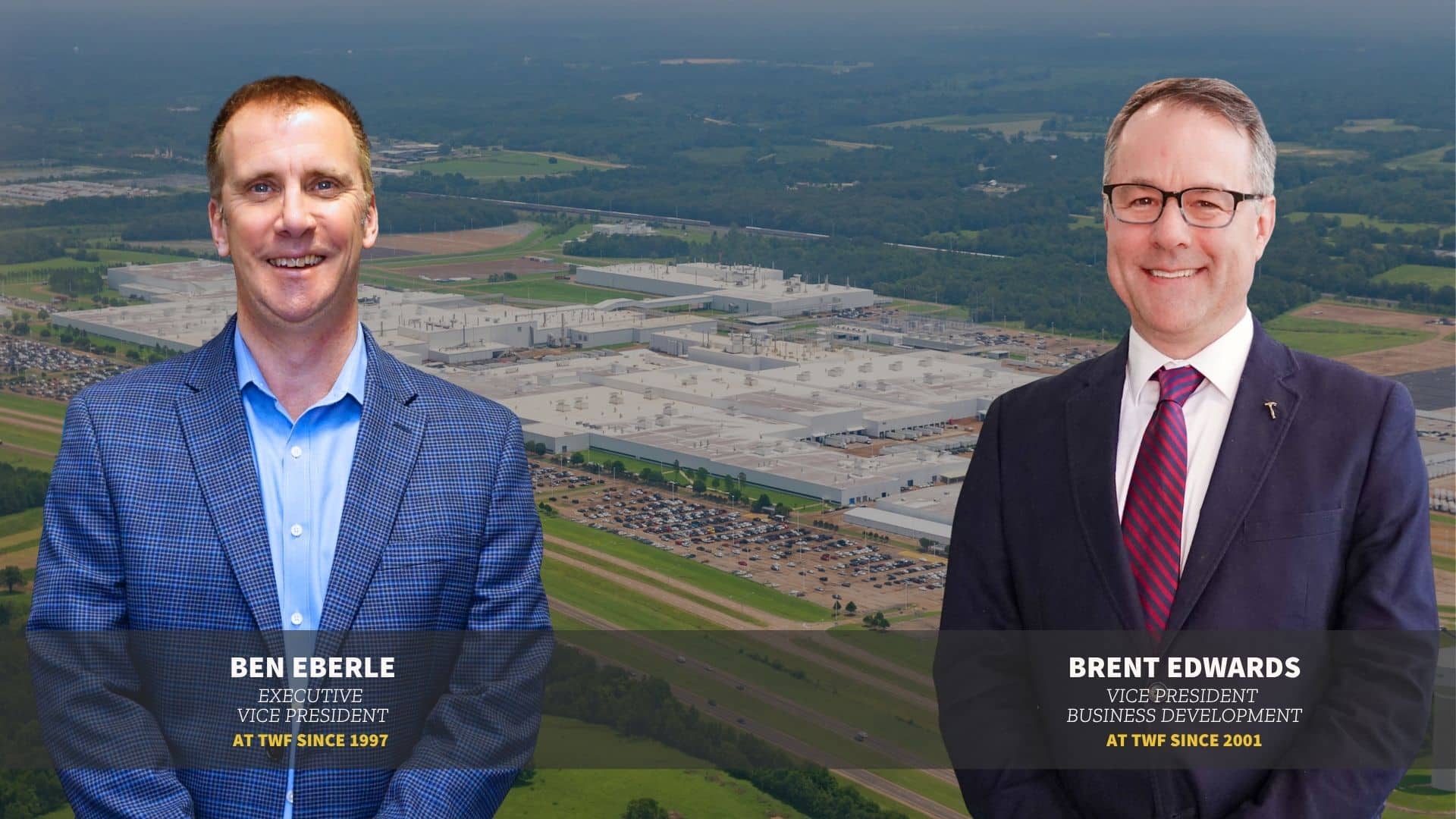
In this engaging discussion, Ben Eberle and Brent Edwards reflect on decades of experience in industrial construction and the meaningful impact their work has had, both professionally and personally. What begins as a conversation of career journeys quickly evolves into a deeper look at the often-overlooked world of industrial building, where the true value isn’t always visible from the outside, but is critical to the success of businesses, communities, and entire industries.
Through stories, lessons learned, and shared perspective, Ben and Brent highlight what makes industrial projects uniquely rewarding; the complexity of systems, the innovation happening behind the scenes, and the craftsmanship required to bring it all together.
From the importance of teamwork and problem-solving in an industry where no two projects are ever the same, to navigating high-risk challenges and delivering solutions, Ben and Brent offer valuable perspectives not only for those in construction but for anyone involved in complex, fast-paced environments.
Looking ahead, Ben and Brent explore the future of industrial construction – where automation and advanced technologies will continue to reshape the industry. At its core, the work will remain deeply human: builders creating the spaces and systems that power innovation, manufacturing, and progress. Their message to the next generation is clear – think big, stay curious, and recognize that the work you do has the potential to make a lasting impact far beyond the jobsite.
VIDEO TRANSCRIPT
INTRODUCTION
Ben: Hey, Ben Eberle here at T.W. Frierson.
I have been blessed to have a career of 28, pushing 29 years, here in the Frierson family. I am here alongside a very dear friend of mine, both personally and professionally. He will introduce himself in a second.
My story is, to make it super short, I started at Earl Swensson when I first moved to Nashville in 1995. I spent two and a half years there and was recruited to come to Frierson by a friend and mentor, David Bockian. Since then, I have moved through a lot of different departments: design, project management, get work, preconstruction. Now, I really love our vivid vision and supporting our employee owners.
Mr. Edwards…
Brent: Thank you, Ben. My story starts many moons ago in Fort Wayne, Indiana.
I attended Purdue, and right out of college, I had the opportunity to work for a design builder who focused on industrial construction. About 25 years ago, I had the opportunity to move to Nashville and took a job with T.W. Frierson. I needed a map to get to work. I did not know anybody in this town. Everything was new. I have been super blessed. I hit the jackpot with the right company. In August, the odometer will roll to 25 years with the company.
That is my story.
WHERE IT ALL STARTED
Ben: Brent, this would have predated you by just a couple of years. In 1997, my introduction to T.W. Frierson was in our design department. We were, not unlike what we have done for many years after that, building for one of our great trade partners. This one was Civil Constructors. It was off Downs Boulevard in Franklin.
I was new and green and did not know anything. Again, David Bockian took me under his wing. At that point, we were going to do a design-build delivery for both their office and their shop. What really stood out to me, Brent, I know you would appreciate this, was the recognition of most specifically the shop, which was the industrial component. Their equipment means everything to them. If their bulldozers, graders, and skid steers are not operational, they are not making money.
The shop was the component that was the lifeblood of their organization. It was really unique and different to me. I had never seen anything like that as a pre-engineered metal building. It was a lot of fun.
Brent: If I can add to that, my previous employer would say that if an industrial manufacturer could set up their equipment in a cornfield, run a big yellow extension cord out to it, and make products and money, they would do it. The building becomes really secondary to the investments that are made, without a doubt.
HOW WE GOT HERE
Ben: Brent, I have a question about industrial construction. My career path, did I know I was going to be designing, then project managing, and building pre-engineered buildings when I was in college in Ohio? Of course not.
Brent: I could imagine you, like me, expected after college that we would go on to build museums, airports, and monuments to society, right?
Ben: Interestingly enough, here is my story from that perspective. I am architecturally trained and, in college, was associated with folks who were visionaries. They were going to change the world. They were going to get on the cover of Architectural Digest. They loved design charrettes. My design deliverables were always rectangles. They were all brick, and they had a couple of punched openings in them. I was definitely subpar when it came to that vision, but I sure loved how they went together.
In that first project, there was an office, and there was a shop, and I gravitated toward the shop. When I started here in Nashville, there was a project architect at Earl Swensson who was a mentor of mine, Greg Maghert, an amazing man. He was a creative genius, and he took me under his wing. He was the guy when Opryland was building the Delta. If you have ever been there, you have seen that complicated skylight system. He basically created that before AI and algorithms, CAD and Revit, on paper. All the angles and the dimensioning, it is artwork, but it is also this crazy engineering feat of how things go together. That is what I appreciated so much.
A DIFFERENT KIND OF WORK, A DIFFERENT KIND OF MIND
Ben: Brent, I do not know if you have recognized this throughout your career, but I certainly have. Industrial folks may be anomalies, a little unique. Some people might call them strange.
Brent: Do not call our clients strange, Ben.
Ben: I am not calling clients. I am calling us.
Brent: Oh, us. Yes, well, that is a given.
Ben: It is really rooted in this. We are sitting here in Nashville, and all you see are tower cranes downtown building these massive skyscrapers. They are beautiful. They are elegant. They have curves.
Brent: They are high profile.
Ben: They are high profile. Many people would say, “Man, that is a sexy project. I want to be a part of that.” Then there is HCA and healthcare, and we are sitting in that epicenter, with all of these plans for the Titans stadium and the East Bank and Northside development.
It is fascinating from an eye candy perspective and has so much purpose. With industrial, it is different because the magic happens inside.
There is a beautiful elegance to an industrial component. Brent and I were on a job site together a couple of weeks ago. We were fascinated walking through.
This was an industrial facility with a warehousing component, but it had all the systems we have been speaking of today: boilers, chillers, air-cooled chillers outside, pump skids in the equipment room, and possibly a reverse osmosis system.
There was a cart sitting on the floor slab that had copper fittings on it. Many of those fittings were custom-made. A craftsman had created a reducing copper fitting that looked sculpted rather than assembled. It was like artwork.
These small details are fascinating about the industrial process to me, and I believe to Brent as well.
REFLECTIONS AND REGRETS
Ben: Something I maybe underestimated, and also regret, is something I want to share with the next generation of folks who go down this path. This applies across market sectors, but specifically to industrial. There are lots of complicated systems and equipment.
There are chillers, boilers, generators, and all the distribution networks that connect them. I remember one of my first premier industrial projects was an aluminum casting plant. It had all of those elements: 40-ton overhead bridge cranes, electrical unit substations, and conductors being routed back through an existing plant, nearly a mile, to a substation.
My regret, and what I underestimated, is that it is important early in your career to learn the systems, not simply execute them.
As a project manager, the work was fast-paced. We had strong trade partners, and they would submit their submittals. I made sure they met the spec. The spec says this, the submittal says that, check, approved, execute.
I did not learn those systems, and that is still something where I have deficiencies today because of that.
I would encourage the next generation of industrial professionals to make sure they learn and ask questions.
Brent: Early in my career, there was a very complicated solvent recovery system for a multicolor printing operation. I did not even know what that meant, except for large ductwork coming off the printers. They were trying to remove VOCs from the air, which involved large cooling towers and a complex control system.
I was young in my career and recognized there was no way I could fake it. I asked the electrical superintendent and the mechanical superintendent to sit with me and show me what I was looking at. I asked how it worked.
I did not know what a flow switch was, an actuated valve, a thermocouple, or a PLC. They walked me through how everything worked.
That was one of the best things I did, and I would encourage anyone to ask questions. All of these systems are complex. The industrial process is complex. Not everyone knows everything, and no one should assume that someone else does.
Do not be hesitant to take the time to understand the process. That is really important.
As I grew up, I saw my father in the auto industry. He worked in a factory doing quality control where they built axles for cars. His whole career was in that segment. At the time, that sounded uninteresting to me, going to the plant every day to make sure things were done the same way.
What I learned early in my career is that there is constant innovation in industrial manufacturing. Someone is always developing a better process or a new method. Companies have laboratories, research, and development. They test new products and new ways to build. That continuous improvement is always happening.
That is one of the more fascinating aspects of industrial work.
Ben: Outstanding.
LESSONS LEARNED
Brent: Ben, anything you want to share that you learned the hard way?
Ben: Sure. This is a slight twist on the question, if I am allowed to adjust it.
Brent: Go ahead.
Ben: I am going to change the question slightly. Early in my career, I experienced something that fortunately was not catastrophic, but it was a post-construction failure.
We were the GC/CM for a manufacturer in Clarksville. It was a strong project with in-plant offices. In those offices, there was a single-floor wing with a mezzanine built over it. The mezzanine was not a heavy industrial structure. It was lightly loaded, as specified.
The ceiling framing consisted of structural studs with connections at bearing points and into a tilt-up wall. Years later, we received a call that the ceiling structure and mezzanine had collapsed over an occupied office.
Thankfully, no one was injured.
A debrief followed. All stakeholders were involved: the engineer, the client, our team, and the trade partner. We discussed the resources used and who installed the structural stud framing.
Here is the lesson I learned. At the time, I believed the issue could be attributed to one of three things: a design flaw, incorrect installation, or the owner exceeding load capacity.
The perspective from our president at the time, Joe Street, changed everything. He provided wise counsel that became foundational in my career. He acknowledged those factors mattered, but they were not the most important issue.
The most important question was how we would work together to restore the facility for the client. We would contribute more than expected and participate regardless of fault.
That is the lesson I took with me and want to pass along. We are in this together. Failures can happen. This industry carries risk. Everything we build has the potential to fail at some point in the future.
Brent: I would say it this way. Everything we do is one of a kind. It has never been done before. Even if we build the same type of facility repeatedly, each project is different.
The weather is different. The site is different. The subcontractors, architect, jurisdiction, and codes are different. Each situation is unique.
While we continue to improve our industry and solve problems, there will always be unknowns. You never know what you will encounter when excavation begins.
The most successful projects are those where teams are aligned.
Ben: Absolutely.
Brent: The example you shared shows alignment during a difficult situation. It is natural to assign blame, but the better approach is to bring the team together and solve the problem collaboratively.
Ben: That is exactly right. Our industry is fundamentally about problem-solving. If everything went perfectly, staffing needs would be significantly lower.
Every day on a job site, there are factors within and outside of our control that can lead to challenges. The key is not the problem itself, but how we respond.
Industrial clients operate with urgency. There is no extended window to resolve issues. Solutions must be immediate, collaborative, and thoughtful.
That responsiveness is critical in industrial work.
BUILDING RELATIONSHIPS, NOT JUST BUILDINGS
Brent: From a business development perspective, industrial clients are unique. Compared to other sectors, such as transportation, the timelines are very different. Transportation projects can take decades due to approvals, land acquisition, and coordination across agencies.
Industrial is often the opposite. It is driven by speed to market. Investors have ideas, validate them, and want to scale quickly. They often bring in additional capital and need to move fast.
That urgency is one of the defining characteristics of industrial clients.
THE WORLD BEHIND WHAT WE USE
Brent: We have all seen the show “How It’s Made.” Everything in this room, every surface, tool, and object, was manufactured somewhere.
That perspective is often overlooked. Early humans made only what they needed. Today, nearly everything around us is manufactured, including our food.
Seeing how products are made is fascinating. Watching processes like leaf spring production, food manufacturing, or automotive assembly provides a deeper appreciation for the complexity behind everyday items.
Ben: There are many common elements across industrial projects, yet each one is unique. Each project introduces a variation in process or system that creates excitement.
Much like “How It’s Made,” you may recognize the equipment, but each application has its own twist. That keeps every project fresh and engaging.
A FEW FAVORITES ALONG THE WAY
Brent: Ben, do you have any favorite industrial projects?
Ben: There are many. Industrial work is not overly complex conceptually, but it requires a strong ability to identify and mitigate risk. Success also depends heavily on relationships.
One project that stands out involved an automotive manufacturing plant near Nashville. For years, we supported their retooling efforts.
This particular project required installing a friction drive conveyor system. It involved excavating deep pits within an operational plant.
Excavation meant cutting through concrete, soil, and rock, all while maintaining plant operations. Dust control was critical. If contaminants entered the air and affected the paint line, it could ruin thousands of vehicles.
We developed strategies including full containment, dust barriers, and negative air systems. Excavation required careful shoring and underpinning due to structural impacts.
Equipment access was limited by overhead systems, requiring creative solutions such as modifying equipment clearance.
This project reinforced the importance of field expertise. Asking questions and learning from experienced team members accelerated my growth significantly.
The most important takeaway was relationship-building. When plant employees trust your intentions and know you are working in their best interest, it makes a significant difference.
Brent: That is a great example.
I have several projects that stand out, but one comes to mind. It involved a stainless steel producer rebuilding an electric arc furnace. The process was complex and physically intense.
Witnessing steel production firsthand is remarkable. It is an extreme environment, transforming raw material into finished product.
Tile manufacturing is another area I find fascinating. At T.W. Frierson, we have completed more tile plants in the U.S. than any other company.
Tile production is unique because it is a complete process. Raw materials enter one end of the facility, and finished product exits the other. That transformation within a single facility is impressive.
Ben: Many people think of tile as a simple product, but it involves a highly sophisticated process. Customization, scale, and consistency all happen under one roof.
Brent: Maintaining consistency across production runs is another impressive aspect. The ability to replicate products over time is a significant challenge.
Ben: Smaller projects can also be impactful. I worked on a clip press relocation project involving disassembled equipment transported from another location.
That project introduced me to millwright work. These professionals specialize in assembling and disassembling complex equipment. Their expertise is essential in industrial construction.
Brent: That highlights an important principle. No one has all the answers. Success comes from connecting the right expertise to the challenge.
Ben: Absolutely.
THE FUTURE OF INDUSTRIAL
Brent: Ben, what do you see for the future? What will the next generation experience?
Ben: Automation, AI, and robotics will continue to evolve and accelerate. However, some fundamentals will remain unchanged.
There will always be a need for skilled trades and hands-on builders. That is encouraging. My son is currently in a welding program, and I am excited to see renewed emphasis on vocational training.
Career and technical education is gaining momentum again, supported by industry and government.
While technology advances, the need for craftsmanship will remain.
Brent: Automation will shift workforce requirements. Tasks that once required many people may now be performed by machines. However, those machines require skilled operators and technicians.
The future workforce will be more specialized, better educated, and likely better compensated. Physical strain may decrease, but problem-solving skills will become even more important.
Ben: One final thought. Industrial work connects to broader advancements, including space exploration. The systems we build contribute to innovations far beyond our immediate projects.
Think big. Your role is not just a title. You are contributing to something larger.
Brent: Do you think we will build a nuclear plant on the moon before we retire?
Ben: Yes, absolutely. It just needs to happen soon.
Brent: That is right.