


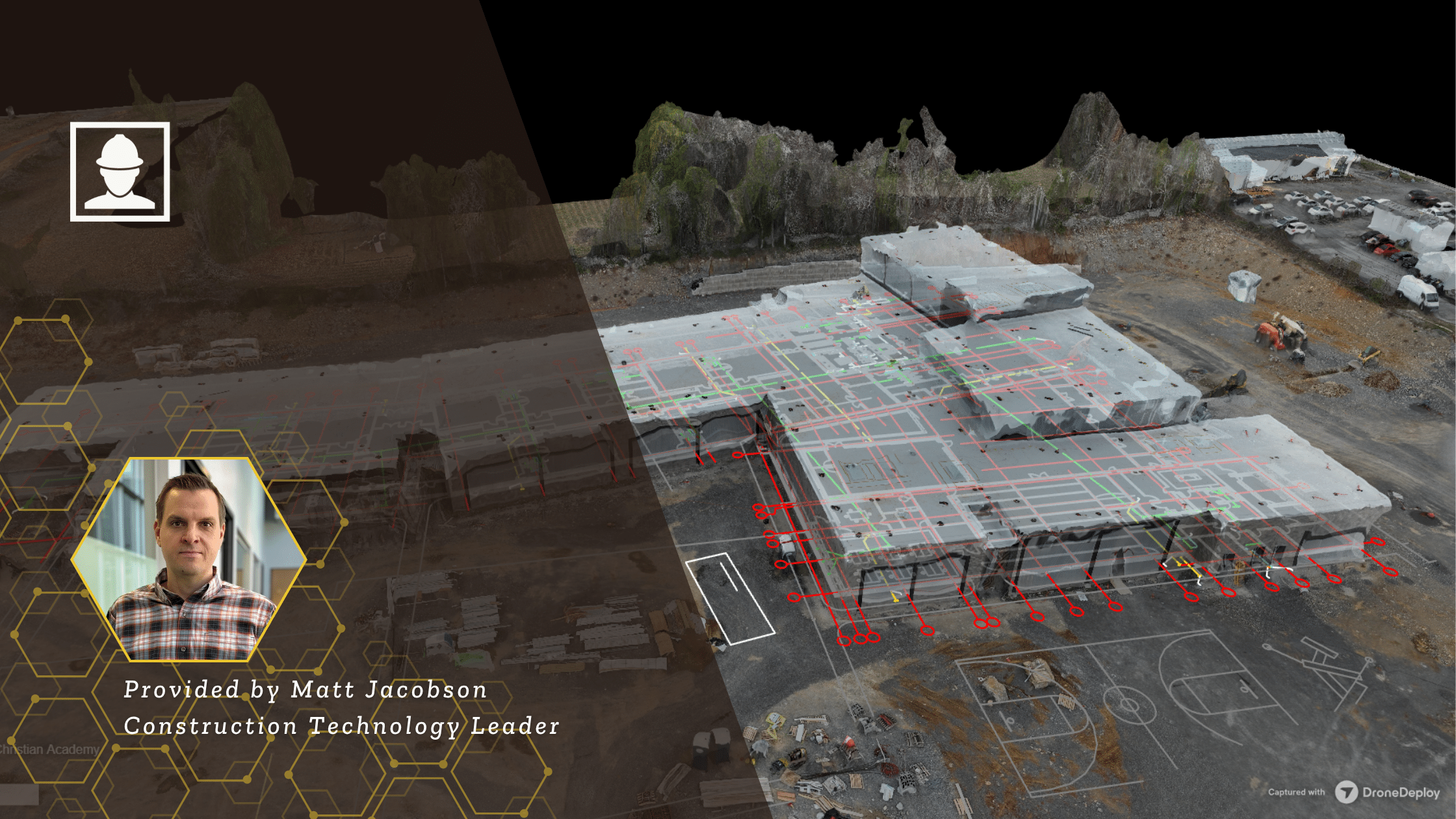
Provided by Matt Jacobson, Construction Technology Leader
October 2026
Safety is not only reactive. It is planned.
That is one of the most important ideas in construction. Rules, training, observations, and corrective actions all matter. But the safest jobsites are not created only by responding well after risk appears. They are created by removing uncertainty before work begins.
Uncertainty is one of the biggest contributors to risk.
When teams do not have clear information, they make assumptions. When sequencing is unclear, trades stack on top of each other. When access is not planned, people improvise. When site conditions are not visible, hazards stay hidden. When schedule pressure increases, decisions get made faster and with less room for error.
That is why construction technology and safety should not be treated as separate conversations.
Technology does not create safety. People do. But the right technology gives people better visibility, better clarity, and more time to make good decisions.
That is where tools like VDC, drones, and emerging AI capabilities are beginning to change how we think about safety. Not by replacing field leadership, but by supporting it.
Safety Starts Before the Work
Safety planning is just as important as safety rules.
Rules help define expectations. Planning helps create the conditions where those expectations can actually be met. If a crew is sent into a congested area with unclear access, conflicting work, incomplete information, or pressure to make up lost time, the risk has already increased before the first task begins.
Better information changes that.
When teams can see the work more clearly, understand constraints earlier, and plan around real conditions, they reduce the need for improvisation. That matters because improvisation under pressure is rarely the safest path.
The goal is not to eliminate every unknown. Construction will always involve changing conditions. The goal is to reduce preventable uncertainty before it reaches the field.
That is the safety value of technology.
It helps teams identify risk while there is still time to plan around it.
How VDC Improves Safety
Virtual Design and Construction is often discussed in terms of coordination, constructability, and schedule. Those are important, but VDC also has a direct safety connection.
A coordinated model helps the team understand how the building will actually come together. It allows superintendents, project managers, trade partners, designers, and safety leaders to look at the same conditions before crews are physically in the space.
That creates better conversations.
Where will access be tight? Where will trades overlap? What needs to be installed first? Can work be completed from the floor instead of from a lift? Can a portion of the work be prefabricated in a controlled environment? Will the planned sequence create congestion? Are we asking crews to solve a problem in the field that should be solved digitally first?
These are safety questions as much as coordination questions.
When VDC is used well, it helps reduce trade stacking, improve sequencing, and identify high-risk conditions earlier. It gives the team a chance to adjust the plan before schedule pressure makes those changes harder.
For example, a dense overhead area may look manageable on a two-dimensional drawing. But once the systems are modeled together, the team may realize that access is limited, installation order matters, and too many trades are planned in the same space. Solving that digitally can reduce rework, avoid congestion, and create a safer path for installation.
VDC does not replace a safety plan. It strengthens it by giving the plan more context.
How Drones Improve Safety
Drones improve safety by reducing unnecessary exposure and expanding jobsite visibility.
There are many conditions that teams need to verify but do not always need to physically access right away. Roofs, façades, active work zones, large sites, elevated conditions, and difficult terrain can all create risk for inspections and progress verification.
Drones provide a safer first look.
They can help teams inspect, document, and verify conditions without immediately sending someone into a hazardous or hard-to-reach area. That does not eliminate the need for in-person inspection, but it helps the team decide where physical access is actually needed.
That is an important distinction.
Safety is not just about responding to hazards. It is about reducing exposure where possible. If a drone can confirm a condition from a safe distance, the team can avoid unnecessary ladder use, lift access, roof exposure, or travel through congested zones.
Drones also help identify hazards earlier.
From above, teams can see site logistics, access constraints, material staging, drainage issues, traffic flow, and areas where work may be stacking up. Those patterns are sometimes hard to recognize from the ground because people are focused on one area at a time.
The aerial view gives leaders a broader perspective.
That perspective supports better planning, better communication, and safer decisions.
Where AI Is Starting to Make an Impact
Artificial intelligence is often discussed in dramatic terms, but its current value in construction safety is more practical.
AI is beginning to help teams review information faster, recognize patterns, and identify trends that may be difficult for people to catch manually. That could include analyzing photos, reviewing safety observations, surfacing repeated issues, or helping teams see where certain types of risk are appearing across projects.
The opportunity is not that AI will replace safety professionals. It will not.
The opportunity is that AI can help safety professionals and field leaders find signals in large amounts of information.
Construction teams already generate photos, reports, observations, inspection records, schedules, RFIs, and daily logs. The challenge is not always a lack of data. The challenge is turning that data into insight quickly enough to prevent problems.
AI can help with that.
If certain conditions keep appearing before incidents or near misses, pattern recognition may help teams act earlier. If photo documentation shows recurring housekeeping issues, access constraints, or missing controls, AI may help flag those trends faster. If reports across multiple projects point to the same recurring exposure, leadership can respond before the issue becomes normalized.
This is where safety can begin moving from reactive reporting toward predictive planning.
That shift will take discipline. AI depends on data quality, clear workflows, and human judgment. Poor inputs will not produce reliable outputs. And no algorithm understands a jobsite better than experienced field leaders.
But as an emerging tool, AI has the potential to help teams see risk earlier and respond more proactively.
Technology Should Empower Field Leadership
The best safety technology supports superintendents and field leaders. It does not bury them in more paperwork.
That matters because field leadership already carries a heavy load. Superintendents are managing schedule, coordination, quality, manpower, logistics, safety, owners, designers, and trade partners. Any tool that adds work without improving decision-making will struggle to earn trust.
Technology has to make the work clearer.
VDC should help leaders plan sequencing and access before crews arrive. Drones should help them see current site conditions without unnecessary exposure. AI should help them identify trends faster, not create another dashboard that no one has time to use.
The purpose is not more data. The purpose is better decisions.
Better information is a form of safety. When leaders can see more clearly, communicate more effectively, and act earlier, they are better equipped to protect people.
That is how technology supports a proactive safety culture.
It gives teams more time to plan, more confidence in the plan, and more visibility into where the plan needs to change.
From Reactive Reporting to Predictive Safety
Construction safety has traditionally relied heavily on observation and response. We inspect, document, correct, and learn. That will always be necessary.
But the future is more proactive.
Predictive safety means using information to identify risk before it becomes an incident. It means looking for patterns instead of isolated events. It means recognizing that schedule pressure, congestion, poor sequencing, unclear access, and changing site conditions are not just operational issues. They are safety signals.
Technology can help make those signals visible.
VDC can reveal risk before construction starts. Drones can reveal changing conditions as the project evolves. AI can help identify trends across images, reports, observations, and project history.
Together, these tools create a stronger safety environment because they reduce uncertainty at different stages of the work.
Before work begins, VDC helps the team plan. During construction, drones help the team see. Across projects, AI can help the organization learn.
That progression matters.
It turns safety from something we manage only in the moment into something we build into the process.
People Create Safety. Technology Supports Them.
Technology and safety are not separate conversations.
They are connected by one simple idea: better information leads to better decisions, and better decisions lead to safer work.
VDC gives teams clarity before crews mobilize. Drones give teams visibility without unnecessary exposure. AI is beginning to help teams recognize patterns before issues repeat. Each tool has a different role, but the purpose is the same.
Reduce uncertainty. Support field leadership. Give people more time and better information to do the work the right way.
Technology does not create safety culture. People create safety culture. Superintendents, foremen, craft professionals, safety leaders, project managers, and trade partners create it through daily decisions and shared accountability.
But technology can strengthen that culture.
It can help teams see risk earlier, plan more clearly, communicate more effectively, and avoid putting people in situations that could have been prevented with better information.
That is the future worth pursuing.
Not technology for its own sake. Not dashboards for the sake of dashboards. Not innovation that looks good in a presentation but adds burden to the field.
The goal is simpler and more important than that. Use technology to remove uncertainty before it becomes risk. Because the safest jobsites are not the ones that react the fastest. They are the ones that plan the best.


